Sunday, 19 April 2015

The problem with sex...

...is that, like irony, once you see it in one place, it seems to pop-up everywhere! 
I’m at the Western Temple complex in Kajuraho (said cadge arow). There are 7 temples, each bearing many explicit, finely crafted reliefs of sex in a joyous multitudinous variety of different forms and positions: oral, anal, men and women, animals, men and animals and male and female masturbation, upside down, back to front, front to back. Some sex seems to be formulaic, dutiful, composed. Some is lustful and abandoned, some surreptitious, some is amorous and sensual, some not so; a man sodomises another man, another stands watching, wanking, whilst a wailing woman raises her eyes to the skies and covers her face in her hands. Strangely, these are interspersed with almost 3-D statues of what appear to be carvings of straight-faced, serious looking men, women and deities, most of whom seem to ignore the sexual abandonment going on all around them. But hang on. I’m not so sure about that. Why the wry smile from that man over there? Is he acknowledging the amorously look from his partner? Where is the hidden arm of the man with the lady who are both staring, straight-laced, out over my head into the distance beyond? Is that the flicker of a smile on her lips? Is that man’s hand gesturing towards a woman’s breast? Is that woman kneeling before a writhing dragon giving it a blow job? Sex here is funny, disruptive and anarchic, spilling over, encouraging the viewer to see it everywhere and subverting everything with its energy.
Whilst the sex is about 3 metres above the base of the seven temples, each also carries a linear narrative relief nearer the ground. I thought that, by circumnavigating each temple, I would quickly interpret the stories. And so it seemed. There are some disagreements, then minor skirmishes, there is preparation for battle, some last minute tooing and froing between the opposing leaders, the large, brutal battle itself and then victory dancing, singing, drumming, flute playing, feasting, more music. The stories around the other temples are more complex and harder to understand and when I arrive back at the first temple again, hoping to reassure myself with the simplest of narratives I’d constructed, it is not there anymore. I have lost the original plot. Instead it, or rather I, am clouded with complications and tangents. There is a long march after the battle which I’d missed, there is another meeting where things are exchanged and there is an animal which seems to whisper into the ear of one of the chiefs, there are lines of birds. What I thought was familiar and straight forward is now not so.

The level of intricate detail that remains for temples over one thousand years old is astonishing. The site was abandoned soon after its construction, invaded by the Afghans, who ironically proceeded to enact in real life some of the scenes of destruction gestured towards on the temples themselves, validating a notion of history, in part, as a struggle for money and land. As a sign of that superiority, the invaders did what invaders seem to do the world over, which is to break many of the statue faces within reach, defacing them to sheered flatness, erasing identities and personalities. But defacing is tiring work and there are so many of them that the vast majority remain, laughing, marching, fighting, loving, eating, music making and fucking, in a vibrant, life affirming, exuberant resistance.


The worst public road I have ever, ever been on. The trip to Satna to catch the train took 4 hours to do 104 km, lurching from one least bad pot hole to another. Avoiding pot holes takes precedence to driving on the right side of the road. Believe me, those coaches take NO prisoners. None. Not one!

Wednesday, 15 April 2015

Udaipur - Lakes and Thunderstorms


I catch the early morning train (1.25am) from Pushkar and arrive at about 6am in Udaipur,
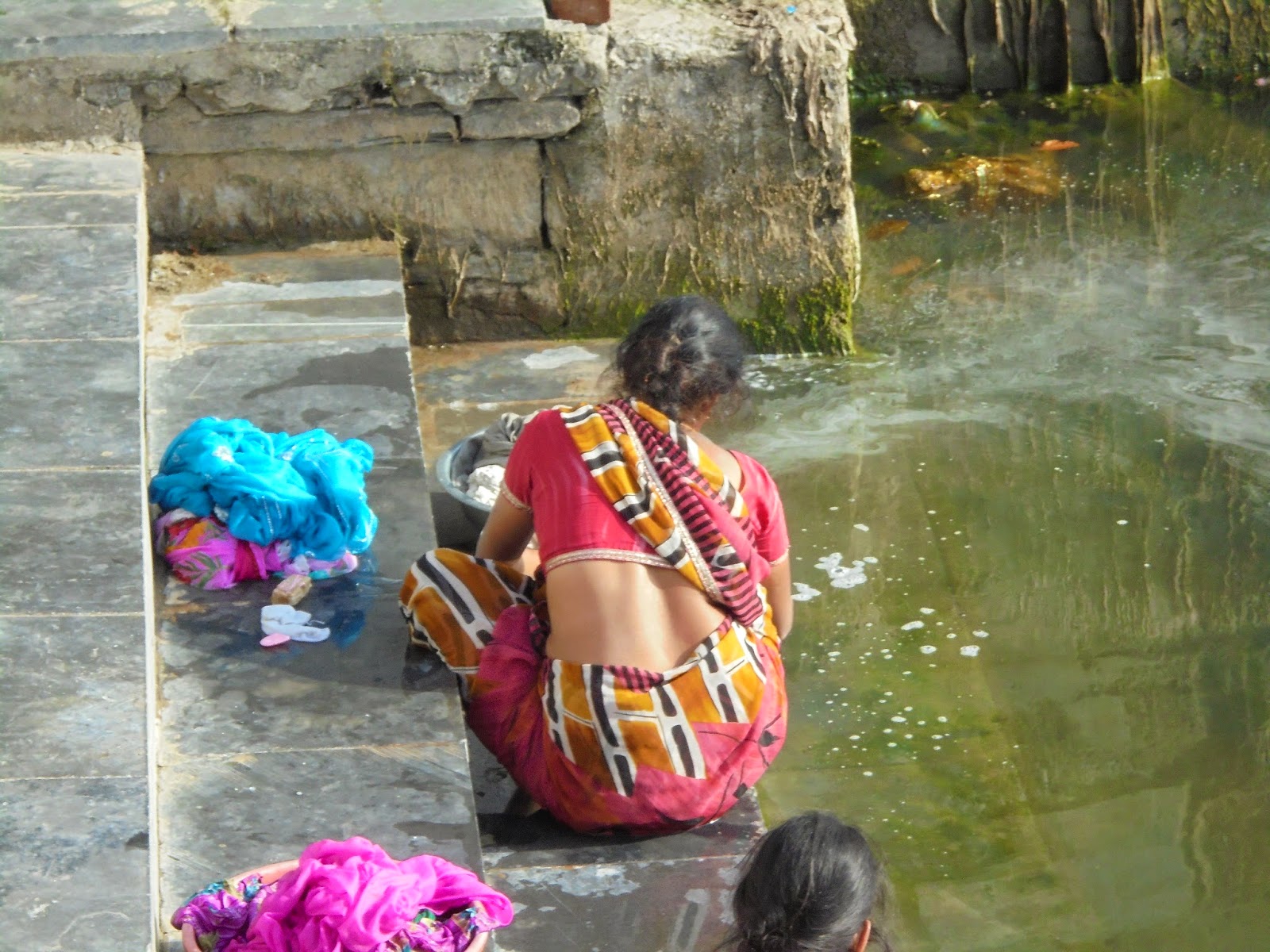
managing to sleep for about 4 hours on the train. Make my way to the hotel on the Western side of the lake. It is very nice, only one line of buildings back from the lake, which I can see from the closed terrace on top of the building. Udaipur is lovely, built around a shimmering blue lake and surrounded by green, verdant hills. It is still very hot, but a cool breeze flows from the lake. The town is quite clean by Indian standards, possibly the cleanest so far after Jaiselmer. It reminds me a little bit of towns on the French or Italian Riviera; lots of multi-coloured buildings which tumble and jostle down the sides of steep hills to touch the water below. The water in the lake looks clean. There are lots of fish and women, balanced on white steps leading down to the water are washing clothes in the sharp early morning light. They cast the clothes into the water like fishing nets, then gathering the material towards them, they scrub and then hit the clothes with large wooden paddles, the hollow beating sound reverberating across the water.

 I’m typing this now under a dark, wet sky. I’m on the top floor terrace of the hotel, overlooking the lake and the eastern part of the city opposite, just down from the City Palace. The water of the lake, once an inviting, green fresh blue, is now grey. There is a very strong breeze and rain is falling in thick, swirling curtains of water. Sheet lightening brightens the sky frequently as the dark thunderclouds roll with a deep rumble around the hills that form a natural basin for Lake Pichola. Only the hills immediately surrounding the lake are visible. Those beyond are hidden by dark, angry clouds. It has been raining and thundering for 3 or 4 hours now. I am still damp from walking around the City Palace. The rain is so heavy that it pours from two plastic pipes that jut from the guttering, a solid cascade of water into the street below, occasionally becoming an unkempt spray as the wind catches it and disrupts its ropey rhythm. The Ghats are almost empty now, with just one or two tourists standing at the water’s edge, watching the storm. The workmen that were slowly repairing part of the crumpling Ghat surface opposite are gone now, just a pyramid of stone rubble  and a section of partially worked marble balcony, laying on its side, remaining. Abruptly there is a tremendous clap of thunder directly overhead and the building seems to shake for a moment. Below there are screams, as tourists with umbrellas duck instinctively and white and red forked lightening cuts the fabric of the sky to momentarily reveal a glimpse of a jagged infinity beyond the tear. There is a power cut in the hotel and in the City. Apart from the lights on cars and motorcycles as they cross the three bridges I can see over on my right, I cannot see any other lights across the city. The city orchestra of vehicle horns, point and counterpoint, with occasional prolonged and angry interjections, plays out with slightly less vigour and intensity as usual. 
Suddenly there is a light on an arch opposite. The round street lights on the bridge have come on. The city is being illuminated again. The fans in the ceiling of the terrace have started to turn. There are voices in the streets below, the sounds of commerce returning. The glowering sky is less angry now, lifting, light grey and white and in the East, and above the skyline of conical temple tops and telephone masts, a sliver of orange tinged cloud can be seen.

In the evening I eat at a very posh roof top restaurant called Upre. The air after the prolonged downpour is clean and fresh. The food is fantastic and the views of the Eastern side of the City, narcissistically gazing at its own glistening reflection in the waters of the lake below, are very beautiful.

Lake Pichola
Early morning chapati making at a small shrine to Vishnu
Lake from City Palace side
Let's get things into perspective shall we?
Stop, no, Go, no, yes...errrm
She loves me, she loves me not...

Honey? It's over there!
Separating the wheat from the chaff

Thursday, 9 April 2015

Swimming, Eating, Sleeping, Dreaming


Pushkar is located in the hills, about 15km North West of Ajmer and is a Hindu pilgrimage site. It sits on the edge of a lake, in Hindu mythology, formed from the tears of Lord Shiva. It is lush and cool and the air is very clean. My hotel is about 15 minute’s walk from the centre. I have been here for 4 full days. I have only walked to the town 3 times. I have not entered any of the many temples. The town is quite quiet compared with some, with access to the lake via Ghats, or small, marble stepped walkways down to the water. Shoes are removed and placed in a pile or into oblong wooden boxes divided into sections, which the monkeys then raid and remove, distributing various odd shoes around about. It is a Euro-hippy magnet, where young (and old) folks from Europe become ‘authentically’ ethnic. Tradition has it that Brahma the creator came here, smoked some weed and had visions. Well, what do you expect? There is dope readily available and I’m sure that here it is very good, but somehow I’m not tempted. In a place that forbids alcohol, meat and eggs, it seems like something that would just get in the way.

Instead, I have mainly woken early (6am) to the sound of singing from the temples nestled in the hills, sat, swam and eaten - hot, spicy aloo palak with potatoes and lots of fresh, chopped green chillies, vegetable curries with cauliflower and peas, fried tarka daal, lots of plain boiled rice and naan, with mango and banana lassi and water.  I have listened to the birds and cicadas, watched the flight of innumerable species of birds swifting through the trees; green and yellow red billed parrots, with stunning crimson under-sided wings, a large red beaked kingfisher with bright azure blue and shiny blue metallic plumage, peacocks pecking an area of recently cut grass. I have swum twice each day, once before breakfast when the water is breathtakingly cold and then later in the day, when the red and orange dragonflies are flirting in zig-zags across the surface of the water. The landscape has changed each day, from a crisp, early morning freshness, through sharp mid-day intensity, to evenings of kinder, softer shapes and merged colours, to the darkness of night, star filled skies and the sight of bats, hunting in a swinging arc, as though on a giant pendulum.

After the frenetic pace of the last few weeks, it is really nice to just sit, relax, dream and be.

Pushkar High Street
Getting ready to wash in the sacred lake

I know the shoes are smelly, but they are worth a lot of money so pull your socks up and let's get on with it!


Pushkar Lake from one of the many Ghats

View from hotel room balcony
Deep breath and........relax